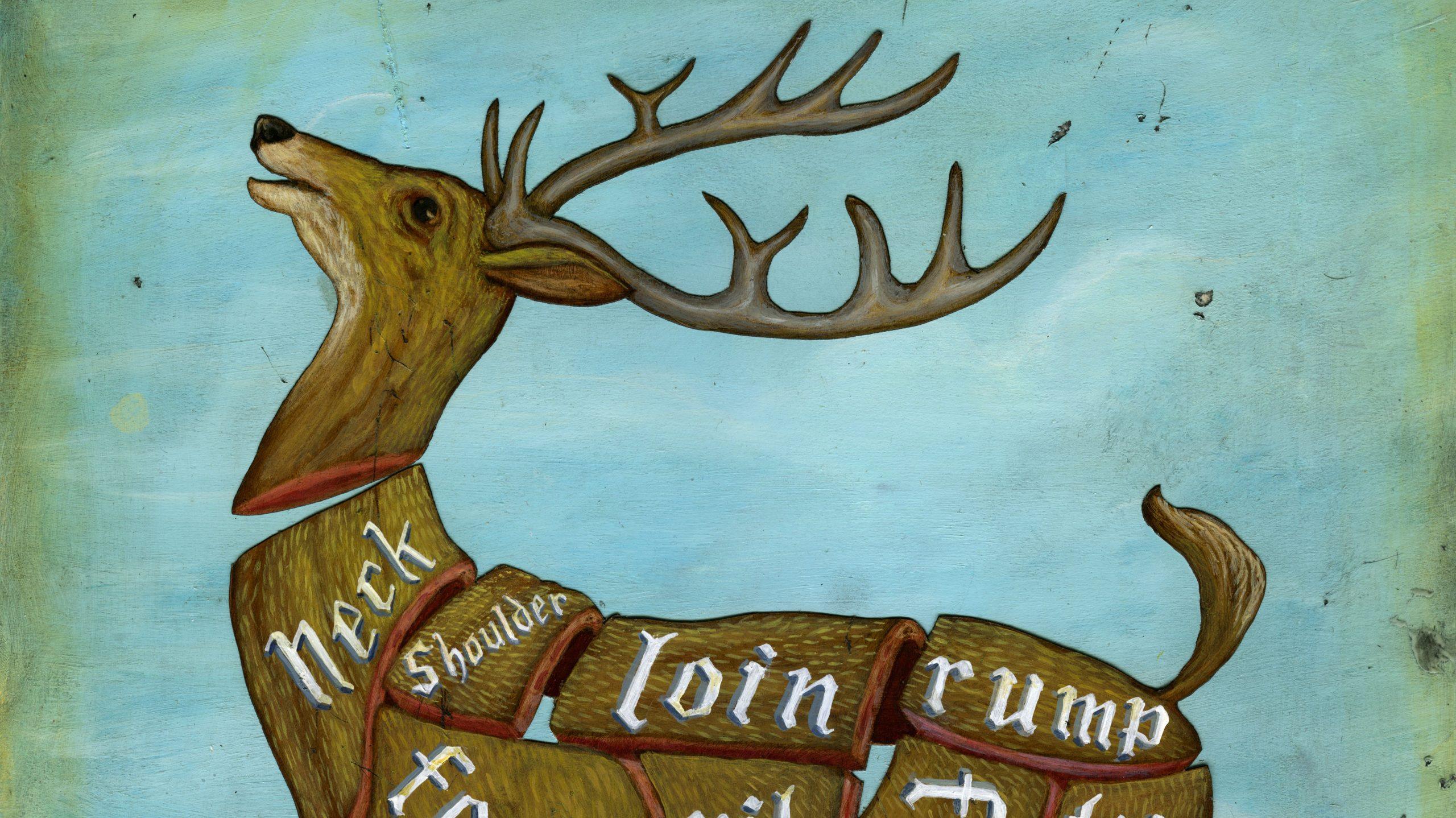
The deer were out there. The crisp tracks in the snow made that clear. Three hours into our hunt through the frigid New Hampshire woods, Ryan Calsbeek, a rangy 51-year-old biology professor at Dartmouth, guessed that 200 animals were hiding in the trees around us. Calsbeek and I were 20 feet up a pignut hickory, crouching on a creaky platform. His friend Max Overstrom-Coleman, a stocky 46-year-old bar owner from Vermont, had climbed a distant tree and strung himself up by a harness, readying his crossbow and swaying in the wind. Shivering in camo jackets and neon-orange beanies, we peered into the darkening forest, daring it to move.
I had joined Calsbeek’s December hunt to try to get my hands on high-quality red meat. Calsbeek had yet to kill a deer that season, but in previous years, he told me, a single animal kept his family of four well fed through the winter. His young daughters especially liked to eat deer heart; apparently, it’s marvelously rich and tender. My mouth watered at the thought. The last time I’d tasted venison was more than a decade ago at a fancy restaurant in Toronto, where it was served as carpaccio, drizzled in oil and so fresh that it may as well have pranced out of the woods and onto my plate.
A bounty of such succulent, free-range meat is currently running through America’s backyards. The continental United States is home to some 30 million white-tailed deer, and in many areas, their numbers are growing too rapidly for comfort. Each year, a white-tailed doe can typically birth up to three fawns, which themselves can reproduce as soon as six months later.
Wherever deer are overabundant, they are at best a nuisance and at worst a plague. They trample gardens, destroy farmland, carry ticks that spread Lyme disease, and disrupt forest ecosystems, allowing invasive species to spread. They are involved in tens of thousands of car crashes each year in New York and New Jersey, where state wildlife departments have encouraged hunters to harvest more deer. In especially populated regions, wildlife agencies hire sharpshooters to cull the animals. Last year, New Hampshire legislators expanded the deer-hunting season in an attempt to keep the population under control. By the looks of the forest floor, which was pitted with hoof marks and scattered with marble-shaped droppings, that effort was falling short.
Over the past decade, some states have proposed a simple, if controversial, strategy for bringing deer under control: Couldn’t people like me—who don’t hunt but aren’t opposed to it—eat more venison?
Venison may not be a staple of American cuisine, but it has a place in many people’s diets. Health influencers laud it as a lean, low-calorie, nutrient-dense source of protein. Venison jerky sticks are sold at big-box stores and advertised as snacks for people on Whole30 and keto diets. Higher-end grocery stores, such as Wegmans and Whole Foods, sell ground venison for upwards of $12 a pound, roughly twice the cost of ground beef.
Part of the reason venison is so expensive is that most of it is not homegrown. It’s mostly imported from New Zealand, which has sent more than 5 million pounds of the stuff to the U.S. every year since 2020. Beef, the dominant red meat in the States, has historically been more affordable. But beef prices jumped nearly 15 percent in 2025, and the conventional kind sold in most supermarkets comes from cattle raised in abysmal conditions. If high-quality venison were cheaper and more widely available, it could be an appetizing alternative.
In recent years, a few deer-swamped states, including New Jersey and Maryland, have tried to legalize the sale of hunted venison, which would deliver two key benefits: more deer out of the ecosystem and more venison on people’s plates. Despite the sport’s association with trophies, many deer hunters are motivated by the prospect of obtaining meat, and they can only consume so much. “It’s for your own table,” Overstrom-Coleman said as he fixed climbing sticks onto a tree to form a makeshift ladder. He had already stocked his freezer full of venison this season (“That son of a bitch,” Calsbeek whispered, once we’d left our companion in his tree) and planned, as many hunters do, to donate any excess meat to a food bank.
Hunting is waning in popularity, in part because younger people are less keen on participating than older generations. Efforts to bring in more hunters, such as programs to train women and youth in outdoor skills, are under way in many states. Women are the fastest-growing demographic, and they participate largely to acquire food, Moira Tidball, the executive director at the Cornell Cooperative Extension who leads hunting classes for women, told me. Still, interest is not growing fast enough for the subsistence-and-donation system to keep deer numbers in check.
[Read: America needs hunting more than it knows]
It’s hard to imagine a better incentive for deer hunting than allowing hunters to sell their venison to stores and restaurants. But the idea is antithetical to a core tenet of American conservation. For more than 100 years, the country’s wild game has flourished under the protection of hunters and their allies, steadfast in their belief that the nation’s animals are not for sale.
The last time this many white-tailed deer roamed America’s woodlands, the country didn’t yet exist. To the English colonists who arrived in the New World, the deer bounding merrily through the forests may as well have been leaping bags of cash. Back home, deer belonged to the Crown, and as such, could be hunted only by the privileged few, Keith Tidball, a hunter and an environmental anthropologist at Cornell (and Moira’s spouse), told me. In the colonies, they were free for the taking.
Colonists founded a robust trans-Atlantic trade for deer hide, a particularly popular leather for making work boots and breeches, which drastically reduced the deer population. In Walden, Henry David Thoreau notes a man who preserved the horns “of the last deer that was killed in this vicinity.” The animals were already close to disappearing from many areas at the beginning of what ecologists have called the “exploitation era” of white-tailed deer, starting in the mid-19th century. Fifty years later, America was home to roughly half a million deer, down 99 percent from precolonial days.
The commerce-driven decimation of the nation’s wildlife—not just deer but birds, elk, bears, and many other animals—unsettled many Americans, especially hunters. In 1900, Representative John Lacey of Iowa, a hunter and close friend of Theodore Roosevelt’s, introduced a bill to ban the trafficking of America’s wildlife. (As Roosevelt, who notoriously hunted to collect trophies, wrote in 1913, “If there is to be any shooting there must be something to shoot.”) The Lacey Act remains one of the most binding federal conservation laws in existence today.
[From the May 1906 issue: Camping with President Theodore Roosevelt]
The law is partly contingent on state policies, which make exceptions for certain species. Hunters in most states, for example, can legally harvest and sell the pelts of fur-bearing species such as otters, raccoons, and coyotes. But attempts to carve out similar exceptions for hunted venison, including the bills in Maryland and New Jersey, have failed. In 2022, the Mississippi attorney general published a statement that opened up the possibility of legalizing the sale of hunted deer, provoking fierce opposition from hunters and conservationists; today, the option remains open but has not led to any policy changes. Last year, an Indiana state representative introduced a bill that would allow the sale of hunted venison, but so far it has gone nowhere.
The practical reason such proposals keep failing is that allowing the sale of hunted meat would require huge investments in infrastructure. Systems to process meat according to state and federal laws would have to be developed, as would rapid testing for chronic wasting disease, an illness akin to mad cow that could, theoretically, spread to humans who eat infected meat, though no cases have ever been reported. Such systems could, of course, be implemented. Hunted deer is sold in some common grocery stores in the United Kingdom, such as Waitrose and Aldi. (Notably, chronic wasting disease is not a concern there.)
[Read: Deer are beta-testing a nightmare disease]
Although the sheer abundance of deer makes them easy to imagine as steaks on legs, several experts cautioned that some people’s affection for the animals runs deep. Deer are cute; they’re docile; they’re Bambi. David Drake, a forestry and wildlife professor at the University of Wisconsin at Madison, likens them to America’s “sacred cow.” As Drake and a colleague have outlined in a paper proposing a model for commercialized venison hunting in the U.S., any modern system would be fundamentally different from the colonial-era approach because it would be regulated, mostly by state wildlife agencies. But powerful coalitions of hunters and conservationists remain both faithful to the notion that wild game shouldn’t be sold and fearful that history will repeat itself. As the Congressional Sportsmen’s Foundation, a national hunting association, puts it, “Any effort to recreate markets for game species represents a significant threat to the future of our nation’s sportsmen-led conservation efforts.” Some of the fiercest pushback to the New Jersey law, Drake told me, came from the state wildlife agency.
The only U.S. state with a deer-related exception to the Lacey Act is Vermont. During the open deer-hunting season (which spans roughly from fall to winter in the Northeast) and for 20 days afterward, Vermonters can legally sell any meat that they harvest. This policy was introduced in 1961, and yet, “I am not aware of anyone who actually takes advantage of it,” Nick Fortin, a wildlife biologist at Vermont’s Fish and Wildlife Department, told me. He added that the department, which manages the exasperated homeowners and destabilized forests that deer leave in their path, has been discussing how to raise awareness about the law.
Even after I explained the 1961 law to several Vermont hunters, they were hesitant to sell me any meat. Hunted meat is meant to be shared freely, or at most bartered for other items or goodwill, Greg Boglioli, a Vermont hunter and store owner, told me. I met Boglioli at the rural home of his friend Fred Waite, a lifelong hunter whose front room alone was decorated with 20 deer heads. I had hoped to buy venison from Waite, but he insisted on sharing it for free. After all, he had plenty. His pantry was crammed with mason jars of stewed venison in liver-colored brine. On a table in the living room was the scarlet torso of a deer that his son had accidentally hit with his truck the other day, half-thawed and waiting to be cooked.
During our hunt, I found Overstrom-Coleman to be more open to the idea of selling the venison he hunted. “I guess that would be a pretty excellent way to share it,” he said. Earlier in the season, he’d killed a deer in Vermont, and he was willing to sell me some of the meat the next day. At least, I thought as I stared into the motionless woods, I’d be going home with something.
[From the July/August 2005 issue: Masters of the hunt]
By the time the sun went down, the only deer I’d seen was a teetering doe in a video that Overstrom-Coleman had taken from his tree and sent to Calsbeek. “Too small to kill,” he texted; he’d meet us in the parking lot. The air was glacial as Calsbeek and I trudged empty-handed toward the trailhead, hoofprints glinting mockingly in the light of our headlamps. From the trunk of the car, we took a consolation swig of Wild Turkey from a frosted bottle, and Overstrom-Coleman reminded me to visit the next day.
I found his chest freezer stuffed with paper-wrapped packages stamped with Deer 2025. He handed me three and refused to let me pay. Back home a few days later, I used one to make meatballs. Their sheer depth of flavor—earthy and robust, with a hint of nuttiness—made me wonder why I bothered to eat farmed meat at all.